
AI Review
Summary
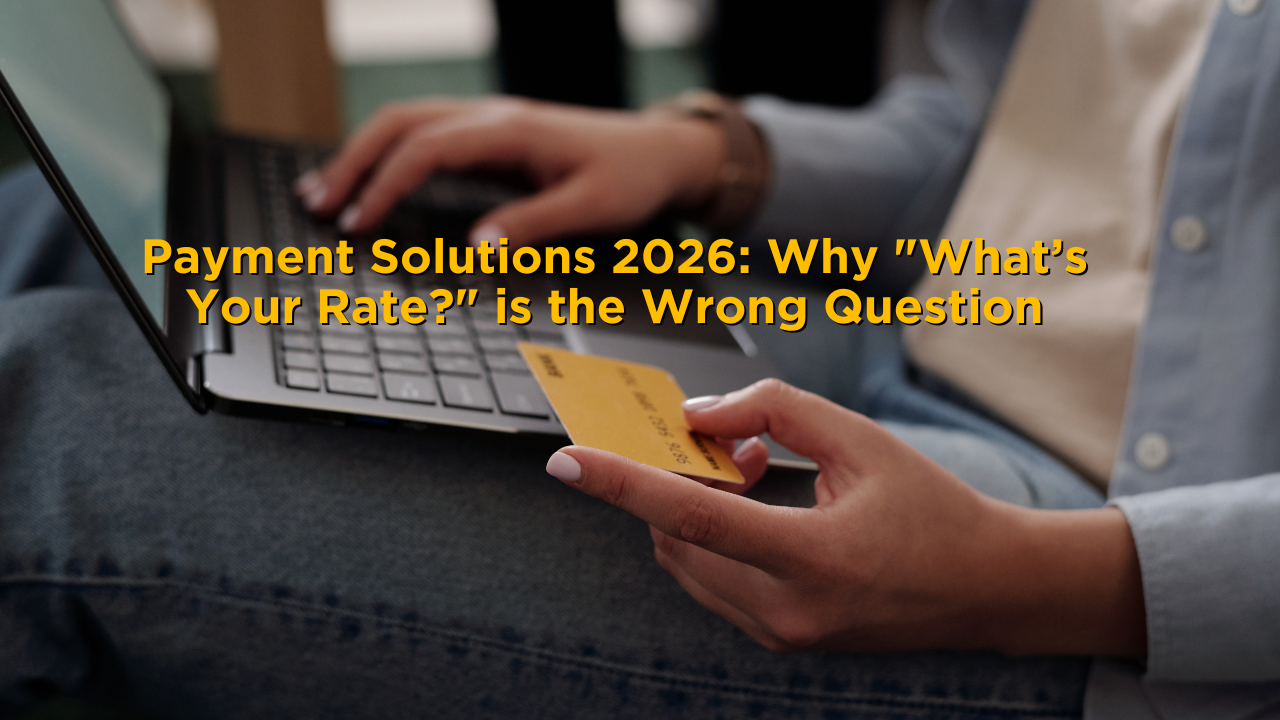
In the current landscape of Payment Solutions 2026, the traditional focus on “transaction rates” has been eclipsed by the need for integrated technology ecosystems. Modern businesses no longer view payments as a utility but as a strategic driver that enables agentic commerce, provides AI-powered fraud defense, and offers instant liquidity. Relying on a “cheap rate” from a disconnected provider often results in hidden operational costs, such as manual reconciliation and account instability. This guide explores why a comprehensive solution—one that merges invoicing, ACH, and accounting sync—is the only way to maintain a competitive edge in 2026.
Why “Payment Solutions” Mean More Than Just Rates in 2026
For years, business owners were trained to ask one question when choosing a payment provider: “What’s your rate?” In 2026, that question is not just outdated—it’s a financial trap. Today’s most successful businesses aren’t buying simple payment processing; they’re investing in payment solutions. These are technology ecosystems that reduce friction, improve cash flow, and integrate directly into the heartbeat of a business.
The 2026 Shift: From Processing to Solutions
Rates are a commodity; solutions are a competitive advantage. In 2026, payments are no longer a “back-office” function. They are embedded into every touchpoint of the customer journey:
-
B2B & Smart Invoicing: Automated requests that bypass PDF attachments.
-
Real-Time Payments (RTP): Utilizing FedNow and A2A (Account-to-Account) rails for instant settlement.
-
Agentic Commerce: Supporting AI agents that transact on behalf of your customers.
-
Omnichannel Identity: Linking tokenized online payments with physical in-store taps.
The Reality Check: A “cheap rate” that lacks these integrations often costs more in manual labor, reconciliation errors, and lost conversion opportunities.
sponsored by
Why Rates Alone No Longer Tell the Full Story
Focusing strictly on a percentage point ignores the four major “hidden costs” of 2026 commerce:
-
Operational Inefficiency: If your team is manually keying data from a terminal into QuickBooks, you aren’t saving money; you’re losing it on payroll.
-
Cash Flow Delays: In an era of instant economy, waiting 2–3 business days for funds to clear is an unnecessary drag on growth.
-
Advanced Fraud Exposure: 2026 has seen a rise in “Identity-Level” fraud. Low-cost processors rarely offer the AI-driven shields needed to stop sophisticated deepfake or synthetic identity attacks.
-
Support Ghosting: When an algorithm freezes your account, “rate-only” providers leave you stuck with a chatbot. A true solution provides a human relationship manager.
The Anatomy of a Modern Payment Solution
A 2026 payment solution is software-first, not rate-first. It acts as a bridge between your bank, your customers, and your accounting software.
| Feature | Legacy Processing | 2026 Payment Solution |
| Primary Goal | Minimize per-transaction cost | Maximize business efficiency |
| Invoicing | Manual / Static | Smart Invoicing with “Pay Now” |
| Settlement | T+2 or T+3 Days | Real-Time / Same-Day |
| Data Flow | Fragmented / Manual | 2-Way Accounting Sync |
| Security | Basic PCI Compliance | AI-Driven Identity Protection |
| Customer Support | Ticket-based / Bot | Dedicated Human Partner |
The Verdict: Outcomes vs. Line Items
Business owners are moving away from “free” or flat-rate platforms that monetize by holding funds or limiting payment methods. In 2026, the goal is control.
The right payment solution helps you:
-
Get paid faster via multiple rails (Card, ACH, RTP).
-
Reduce disputes through better policy transparency.
-
Scale without switching platforms as you grow.
Learn More About Modern, AI-Ready Payment Systems
To explore how intelligent payment platforms combine payments, automation, invoicing, and real-world business needs, visit
👉 https://nationwidepaymentsystems.com
FREQUENTLY ASKED QUESTIONS
1. Is a 2.9% flat rate still a good deal in 2026?
Generally, no. For any business processing over $10k/month, flat rates usually hide a significant “convenience tax” compared to interchange-plus models.
2. What is “Agentic Commerce” support?
It refers to a payment solution’s ability to securely authorize transactions initiated by AI agents (like a customer’s shopping bot) using tokenization and modern identity protocols.
3. Why is ACH becoming more popular than credit cards for B2B?
With real-time ACH rails fully mature in 2026, businesses can receive large payments instantly for a flat fee rather than a percentage, saving thousands in fees.
4. Does a “Payment Solution” include my hardware?
Yes. Modern solutions integrate your Point-of-Sale (POS) hardware with your online dashboard so inventory and sales data are never out of sync.
5. How does a solution help with chargebacks?
By using AI to verify the buyer’s digital identity and requiring explicit “terms of service” checkboxes, solutions provide the evidence needed to win disputes automatically.
6. Can I keep my existing bank if I switch to a new payment solution?
Absolutely. A dedicated solution provider can route your funds to any existing business checking account seamlessly.
7. What is “2-Way Sync”?
It means if you update an invoice in your payment portal, it automatically updates in QuickBooks (and vice versa), ensuring your books are always accurate.
8. Are real-time payments (RTP) safe?
Yes. By 2026, RTP systems like FedNow use advanced “Confirmation of Payee” and AI-driven fraud analytics to ensure funds reach the correct account instantly and safely.
9. Why do “rate-only” providers have more account freezes?
Because they don’t underwrite you upfront. They use broad algorithms that often “freeze first and ask questions later” when they see a transaction spike.
10. What should be my first step in upgrading?
Review your last three processing statements and calculate the time your staff spends on reconciliation. That “labor cost” is your real processing rate.